Nova Europa
The Disappearance of Josef MengeleNova Europa is the Brazilian rural setting of one of Josef Mengele’s periods in hiding, on an isolated farm owned by Geza Stammer and Gitta Stammer. There, under the assumed identity of Peter Hochbichler, he was presented as a Swiss livestock specialist and worked on the smallholding. The place offered concealment through its remoteness and the Stammers’ willingness to shelter him, but its austere conditions and the discovery of who he was made that refuge precarious.
Setting and Arrival
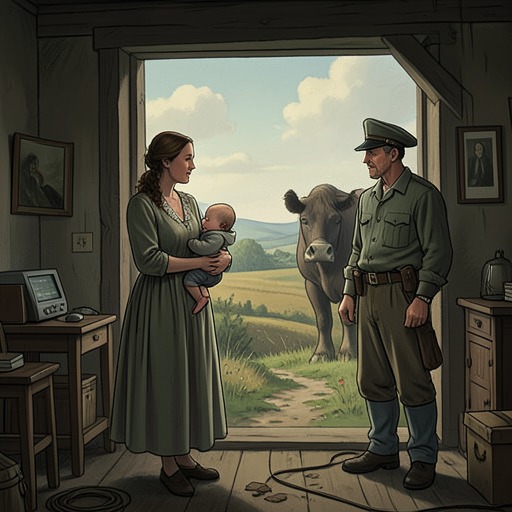
Mengele reached the farm near Nova Europa after leaving Itapecerica shortly before eight in the morning in a modest Ford Anglia driven by Gerhard. Their route led north, away from the city, as the landscape grew more arid; the paved road narrowed to a track and then a dusty lane winding through savannah. The journey ended at an old farm, where dogs barked around the car and the Stammer family waited at the wooden house to meet the mysterious guest Gerhard had described.
The farm belonged to a Hungarian couple who had left their country after the war and Soviet invasion. Gerhard had met them among Central European expatriates and regarded them as politically sympathetic and unlikely to cause trouble. He introduced Mengele as Peter Hochbichler: a fifty-year-old Swiss livestock-breeding specialist, recently troubled by ill health, seeking company and work, and newly in possession of money he hoped to invest in land. Because Geza Stammer worked as a surveyor and was often away for long periods, the supposed specialist could manage the farm. The arrangement was that the Stammers would feed, house, and conceal Hochbichler, without paying him wages.
Work and the Farm’s Hardship
Mengele’s adjustment to Nova Europa was difficult. He arrived at the beginning of the dry season, and the heat at the end of 1961 was described as exceptional. The year brought no rain before Christmas; nights felt more suffocating than at Krug’s place in Hohenau. The soil was arid, and farm work was strenuous. The Stammers lived on the smallholding with neither telephone nor electricity, conditions that made the place isolated in practical as well as geographic terms.
On the coffee plantation, Gitta Stammer watched the new worker closely. He began at dawn and stayed in the fields later than the other workers, attending to the cows, hens, mare, and three pigs. He whistled Mozart and Puccini while working. After a month, the Stammers—particularly Gitta, since Geza Stammer was home only some weekends—decided to keep him on, despite finding him both needy and strangely narcissistic.
His habits made the disguise seem both ordinary and conspicuous. Before going to the fields, he splashed on eau de Cologne and languidly inspected himself in the entrance-hall mirror. He kept his hat on and pulled it over his face when approached. Even in the oppressive heat he wore heavy boots and a white gabardine coat buttoned to the neck. His hands combined the signs of manual work with meticulous grooming: calloused palms and knuckles, carefully manicured nails, frequent washing, and vigorous scrubbing of his forearms with black soap. At the same time, he could perform the practical work of the farm kitchen. Shortly before Christmas he killed a pig with an axe, collected and stirred its blood to make blood pudding, and prepared the animal’s organs and intestines. The Stammers, their workers, and their families ate the food at New Year’s Eve.
Discovery of Hochbichler’s Identity
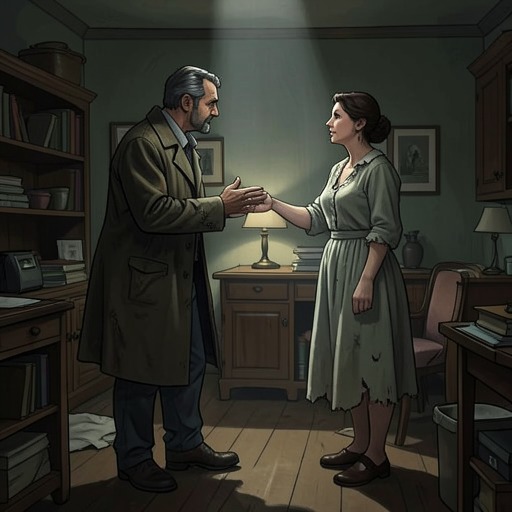
The concealment began to fail when Gitta Stammer entered Mengele’s room one morning while he was out working. He had unusually forgotten to lock the door. Among folded designer clothes, she found an English umbrella, bundles of high-denomination dollar bills, Spanish- and German-language newspapers and scientific journals, a padlocked notebook, papers she did not dare decipher, opera recordings, and books by unfamiliar authors including Heidegger, Carl Schmitt, Novalis, and Heinrich von Treitschke. The assortment revealed a life and resources far beyond those of the needy farmhand Gerhard had described, although she did not yet know the full explanation.
The decisive clue came on Saturday, 27 January 1962. Geza Stammer brought home a São Paulo broadsheet commemorating the seventeenth anniversary of the liberation of Auschwitz concentration camp. It printed a photograph of Josef Mengele, the SS doctor still being sought and known as the Angel of Death. Gitta Stammer recognized the face from its piercing gaze, distinctive eyebrows, gap between the front teeth, and slightly domed forehead. She sent her eldest son, Roberto, to fetch Hochbichler and showed him the photograph. Trembling and pale, he left without a word.
That evening, after barely touching his meal, the supposed Swiss farmer admitted to the Stammers that he was Mengele. He denied the crimes attributed to him, blaming the press for accusations made under Jewish direction. The admission changed the meaning of the farm’s hospitality: the Stammers were no longer simply housing an eccentric immigrant but knowingly sheltering a wanted Nazi fugitive. Their response was shaped less by concern about the accusations than by their own hardship and desire for security. They had suffered losses and displacement, and wanted peace; at the same time, they worried about the police, their sons’ future, and the risks of keeping him.
Departure and Significance
The Stammers’ dispute over whether to continue the arrangement ended in a practical bargain. Geza Stammer eventually accepted Gitta Stammer’s arguments and conveyed their demands to Gerhard in São Paulo. The Mengele family agreed to provide half the capital for a new farm; the Stammers would find the property and sell their Nova Europa land to cover the remainder. A few weeks later, the Stammers and Mengele left for an isolated farmhouse in Serra Negra, surrounded by forty-five hectares. The move took place five months before Mossad found Yossele.
Nova Europa therefore marks a temporary stage in Mengele’s Brazilian concealment rather than a permanent home. Its remoteness enabled him to work under an alias, while its farm routines exposed the contradictions of that assumed identity: the industrious livestock specialist was also guarded about his face, fastidious about his body, and in possession of concealed money, papers, and books. The newspaper photograph brought those clues together, and the refuge continued only after the Stammers’ financial demands were met. The farm’s significance lies in that progression—from a hiding place arranged by Gerhard, to a household that learned its guest’s identity, to a temporary shelter abandoned for a new property.